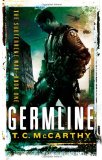
After devouring the first two parts of Ian Tregillis’ Milkweed Triptych, I was given as a bonus item the first chapter of T. C. McCarthy’s Germline, which seemed a fairly gung-ho future war story. But it was for free and I was in a bookshop in Taipei two weekends ago, so when I found the trilogy I picked them all up and read through them in a couple of days.

Germline tells the story of a journalist, embedded with US Marines. In tunnels, deep underground, where there is no water. Do Marines do anything marine, I wonder? These are soldiers into heavy duty battlesuits, and McCarthy is the first author I’ve read who has engaged with the thorny question of how soldiers in heavy duty battlesuits go to the toilet. These guys are stuck deep underground, for months at a time. That’s why it’s called the Subterrene Trilogy.
Well, because they’re subterreanean, and because they’re military they have no time for speaking in unabbreviated sentences, because they are busy blowing things up. I had strange thoughts of some deaf marines, stuck in an old folks’ home, reliving the horrors of the Soup Tureen War, but that’s for another day.
There is no soup in the Subterrene War, and even fewer tureens. More’s the pity.
So anyway, there they are, down a hole in Kazahkstan, with no way to take their armour off, so every soldier has a valve and can crap out of their suit into a handy septic tank. Or just onto the floor, because they are Men, and Men Will Not Tidy Up After Themselves. A few months down the hole, and apparently the marines and everything around them are covered in crap.
They also all have ulcerative colitis from where the suit valve is jammed up their butt, which suggests the novel is an extended metaphor for (a) American foreign policy shitting on everything or (b) being a soldier is a right pain in the arse.
I’m not sure about metaphors here though, because the whole book seems devoid of subtext the first time you read it. There’s this jaded journalist embedded with the shit-encrusted soldiers, there are elite insane genetically engineered women assassins, and they all fancy the journalist (despite or because he’s high as a kite) and 21st century warfare is World War One trench warfare, but with bigger guns. It’s just bang bang boom boom boom for two hundred pages, until suddenly the war stops and our hero goes home, where he suddenly becomes meditative and then goes to Thailand for some authorial wish-fulfilment with his new girlfriend.
I wonder if it’s a satire of Heinlein, but I haven’t read any Heinlein (I do like watching Starship Troopers, but that’s not necessarily the same thing). Every positive review praises it for being great military sci-fi, when there’s huge questions in the plot like why they’re sending troops in ludicrously inadequate armour to be blown up, or how the US has transformed its economy into one where it’s cheaper to breed and indoctrinate genetic women in factories for sixteen years, than to build drones and have them do the work for you. (I don’t believe that’s because it’s cheaper, when every man in the army can be equipped with a personal railgun, and every vehicle with a fusion reactor, but then I’m not a former CIA analyst.)
It’s just so po-faced, and everything I’ve read of McCarthy in interviews and on his blog also seem so serious, that you feel it has to be a joke, extended so far beyond the pages of the novel into the world at large that only a select few realise it’s a pisstake.
Or not.
For volume 2, Exogene, we switch perspective to Catherine, one of the female supersoldiers. She’s “spoiling” because the US doesn’t build genetically modified women to last, and so for the whole book she’s in fear of rotting away both physically and mentally. I previously only encounter “exogene” as part of “exogenous shock” which is what economists use instead of “bloody hell, we didn’t incorporate that in our model” and sadly, Exogene is not much more exciting than economics.


Catherine wanders around for a while, gets captured by Russian supersoldiers (Who Are Not So Very Different After All … but who are also bastards, so she does a runner), works in a North Korean farm, gets in a few more battles and then heads off to Thailand. Everyone in the sous-terroir war ends up in Thailand eventually. It’s like a gap-year destination for professional psychopaths. I wonder if they all get their hair braided on the Khao San road while doing a beer bong together.
Eventually, Exogene comes to a halt. Nothing much has happened.
Chimera picks up a bit later, with a third grumpy protagonist, Stan, whose job is to kill genetically modified supersoldiers, and mope. For a change, he goes to Thailand quite early in the book, and stays there; eventually it becomes clear that we’re reading Apocalypse Now, but with shit-encrusted marines in it. There are some interesting remarks on Asian geopolitics: apparently everyone hates the Chinese. That is all. (About then was when I felt I was in a rocket full of right winger US types still paranoid about the Yellow Peril, just after take-off.)


Oh, and in a previous war, Japan and South Korea teamed up with “Japan, Russia, America, and about half of Taiwan” against China and North Korea. I was so stunned by this that I had to read through the book again to be sure I hadn’t made it up. I didn’t: it’s on page 164. Maybe it’s because I’ve been to Taiwan quite a lot that this seems a big lapse, but Taiwan’s not exactly a huge federation of states, some of which might fight China and some won’t. It’s a fairly small country with not many people in it, and although they’re all pretty friendly people, half of them fighting China? It doesn’t make any sense. Which half didn’t? The guys in Kaohsiung? I thought maybe he meant Thailand, but that survived whereas half of Taiwan got nuked and the rest got squashed from orbit. Blowing up half of Malaysia, which is geographically and politically big enough for that to make sense, maybe, but Taiwan? It makes me start to doubt the descriptions of Kazahkstan in Germline, which up until that point I’d trusted.
Anyway, there’s some more biological superweapons, and some moaning about how restricted the US has become. Sadly that feels more like old codgers on Top Gear complaining about speed cameras than cutting-edge sci-fi, and, as I said, there’s no joy when your universe is full of dried-excrement-covered marines and constant death. Things draw to a close, and it all ends in Thailand. The trilogy didn’t make me contemplate mortality like The Postmortal did; it made me feel like I was watching a scatological remix of GI Joe: Retribution.
On the positive side, the first book is fast paced and yomps along at a good lick. The second book is just gloom gloom gloom, and the third is pretty much like that too, but with extra (and extra-) suicidal Asian types (they all like dying, and they All Hate The Chinese, as explained earlier) running around with big guns / bags over their heads. It’s not quite computer-game junk food, but I don’t think I’ll intentionally read military sci-fi again for a while.