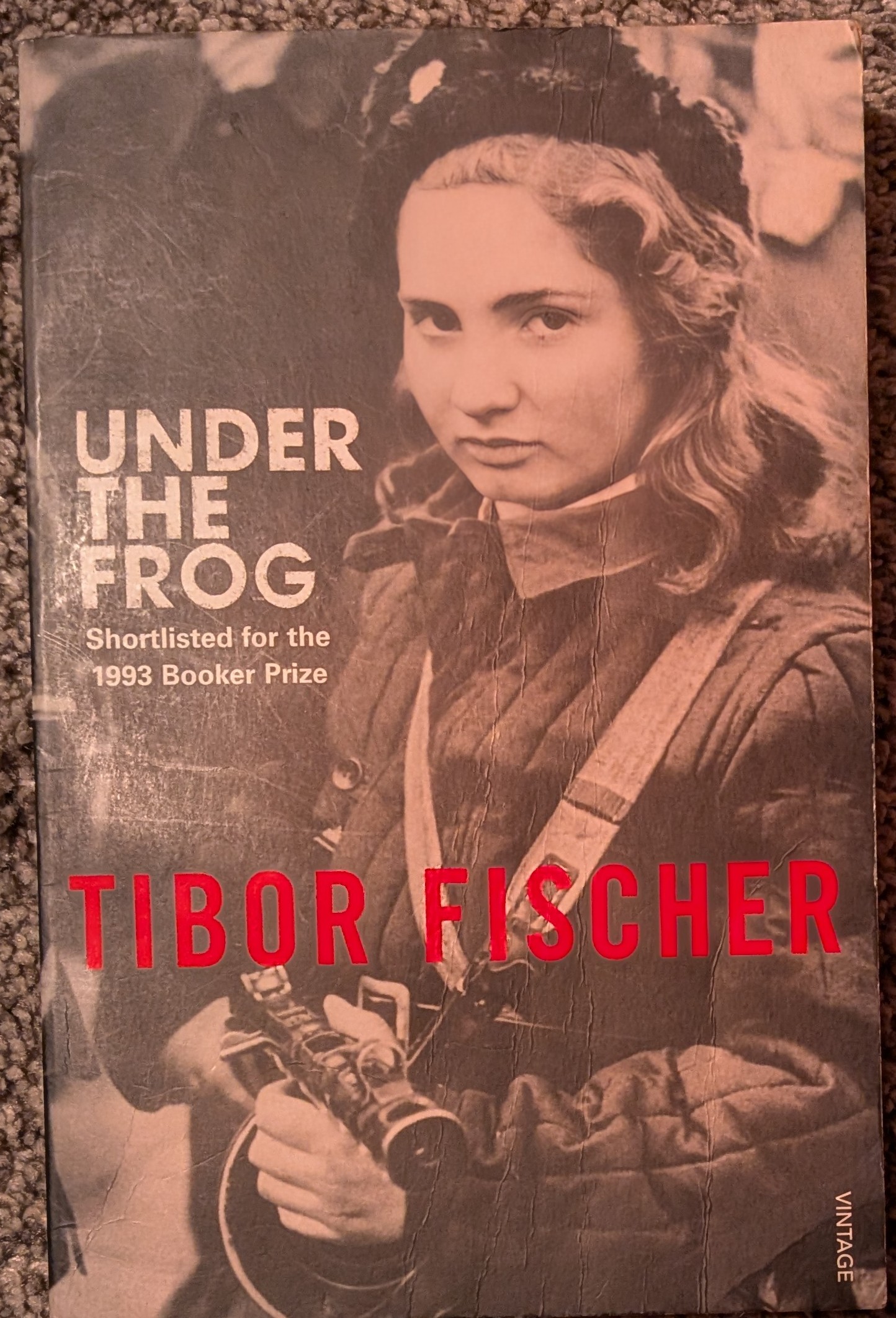
I first read Under The Frog when I was at the sixth form of my school, and all these years later some parts are indelibly inked in my memory: the final sentence, the complaints at a party about the noise people are making by jumping off balconies and breaking their ankles (and then laughing about it) and a practical joke that accidentally involves a huge cache of Nazi munitions hidden in a cave in Hungary.
Like The Great Gatsby , every time I read it I get something different. I don’t think I even realise the first time I read it that the protagonist’s girlfriend died in the events of 1956, but on later readings that part has reliably driven me to tears, like a Hungarian version of Robert Munch’s Love You Forever. I had similar results when I read a biography of Zatopek, the Czech marathon runner, so maybe there’s something about that part of Europe that makes me cry.
This time, reading it to the kids for their bedtime story, I noticed more exactly how many explicit sexual references there were (and just like with The Restraint Of Beasts, had to work on the fly to edit some of these out). I’m not sure if my kids understand what was going on in Hungary in the 50s (when I read it, I didn’t know much, but had the context of knowing about the Soviet Union in the 20s and 30s from my history lessons). And finally, every time I read it I realise I’ve muddled up the order of so many events: the balcony jumping comes near the end, not the start, as one example.
A strange coincidence I found when reading Tibor Fischer’s biography on Wikipedia today: he attended a comprehensive school in Bromley, Kent before university. Wikipedia doesn’t say which, but it’s at least possible that we went to the same school, a quarter of a century apart. I never thought where I grew up was particularly special while I was growing up there, but with hindsight it’s been the locus of many events.