
https://laurenleek.substack.com/p/the-basket-and-the-booza does some interesting work to consider how a more walkable city might result in fewer independent restaurants. I thought I’d see if I could replicate this for Vancouver and Seattle:
- Both are cities in the Pacific Northwest
- Arguably, Vancouver has a much more built-out public transport infrastructure (multiple light rail that’s been established for decades)
How do we define them?
Vancouver
Latitude 49.205 – 49.291, longitude -123.264 to -123.023
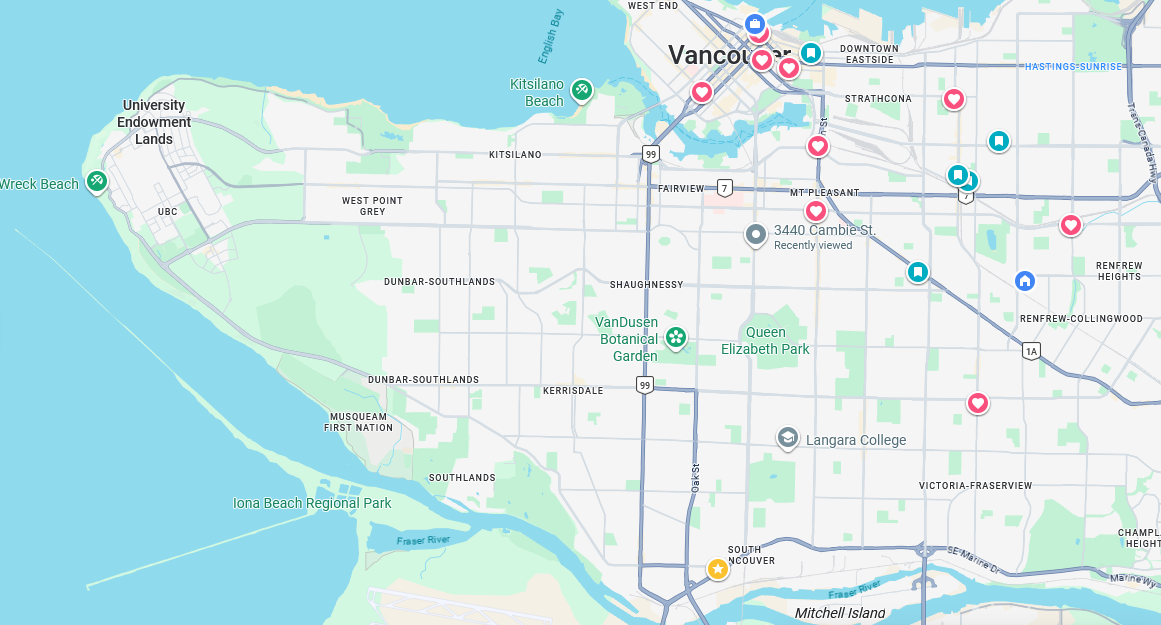
Note that this misses out all of Richmond, Burnaby and North Vancouver, all of which are part of the greater Vancouver area (consider the previous analysis which looked at Greater London, not just central boroughs)
Seattle
47.717507, -122.429603 to 47.550996, -122.258129

Then we run Lauren’s Open Food Map scripts to pull restaurant data (reducing the grid step to 500m, radius 500m, from previous experience (using the default 1.5 km grid step and radius missed out too many restaurants).
Bear in mind that Seattle is much smaller than London. Last time I looked, under a million people live there. Yes, if you expand to King County, that will go up, but then if you compare to Greater London, it will still be dwarfed. Just compare Lauren’s map of London to what I got for Seattle:
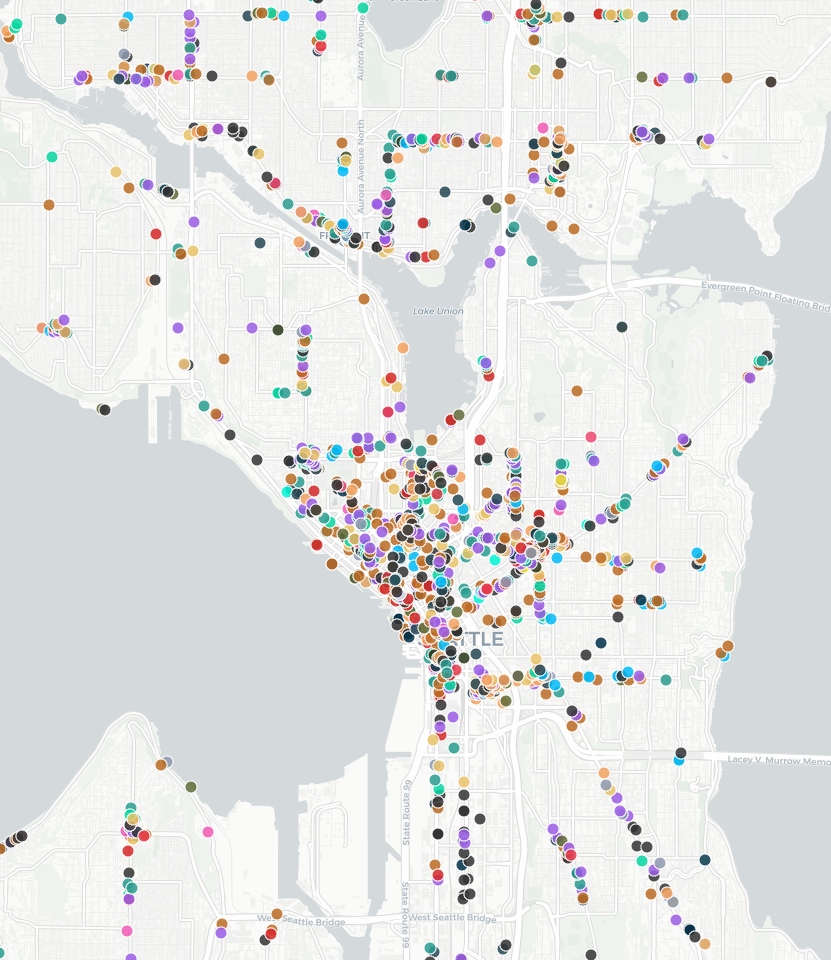
There’s a lot of restaurants south of Lake Union, but not much east of I-5 (the freeway that travels south along the east side of Lake Union). Going further away from the centre of Seattle, you can see that most restaurants are concentrated on a few streets; there’s a long chain going along the waterfront from Fremont, but that’s at the base of a steep hill that’s fully residential – no little eateries exist once your elevation changes even slightly…
However, the reliability of scraping Google is always going to be … problematic. I thought I’d better check and see if Starbucks shows up, and look, here’s the famous original cafe:
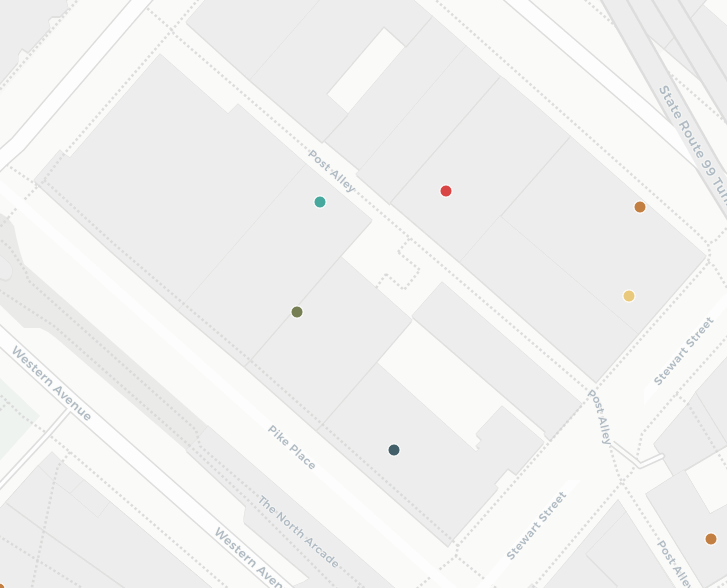
Well, no there isn’t; as I know, from going there, and from looking on Google Maps it’s right here, but on our first scrape of the area we only picked up Emmett Watson’s Oyster Bar and Beecher’s Cheese (neither of them bad establishments per se, but Google wasn’t giving us the full story…
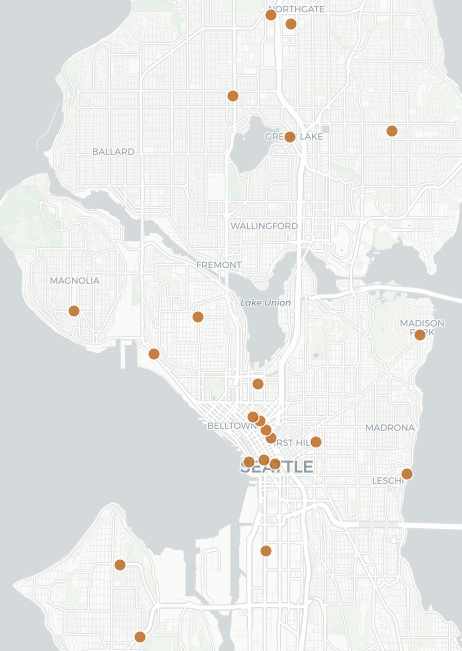
For laughs, here’s how many Starbucks are showing up when we scrape Seattle (have they all gone to Tennessee? surely not…)
Further, when we look at breakdowns of how many restaurants there are, it’s a bit … odd. Of the 2,483 establishments we found, there’s only 169 chains in there. This is partly a function of the scripts trying to infer whether a place is a chain or not, based on a list of (mostly UK-centric) chains – so it’s good at spotting a Wetherspoons or a Greggs, it hasn’t been built to realise Jack In The Box isn’t a mom-and-pop place but part of an empire that got its own Netflix documentary… We can solve that, but it requires elbow grease and local knowledge to figure out some of these. (Lauren’s original definition, that there’s more than two branches in more than two neighbourhoods, works, but only until it breaks – there was only a single Red Robin that we got back in our results, so just looking for n>2 wouldn’t have spotted that). Brute force work to look for obvious contenders gets us up to 236 chain restaurants, which still seems suspiciously low, given London’s numbers (40% chains)