
After work tonight I got on the wrong shuttle home, and then had to walk a mile to get to the hotel. I was booking it home as fast as I could because I had a class booked at the Soul Cycle in the Stanford Shopping Centre, just down the street from the hotel. (Soul Cycle is one of the big names in spinning classes, and has pretty much perfected the whole utterly-mental-totally-enthusiastic-embrace-the-pain ethic that all modern spin studios seem to adhere to.) Although there were lots of press ups and strange movements, it didn’t bring me quite to tears like 7Cycle used to be able to, with its valedictory speeches on how you need to improve your life and its terrible dance music. (Soul Cycle has other terrible music, but that’s by the by.)
I got to Soul Cycle (note that they have soul-cycle.com, whereas soulcycle.com is owned by some sweaty BMX punks that are most likely far removed from skinny Californians in bright yellow Lululemon pants. But never mind.
I left Soul Cycle, fairly exhausted, ate a burrito from Chipotle, and went back to the hotel to shower and pack my bags for Thursday. And at some point, I began to wonder about power.
There are no power meters visible on the Soul Cycle bicycles. The power meter I have is useless, both because it’s designed to measure power output from running, not stationary cycling, and also because the battery on my Garmin was flat and so I wouldn’t have captured any data anyway. But I do have a recording from my last outing to the track, so let’s talk about that.
Here’s my pace for each lap. (I was aiming for a 1:40 lap, which equates to 4:10 pace)
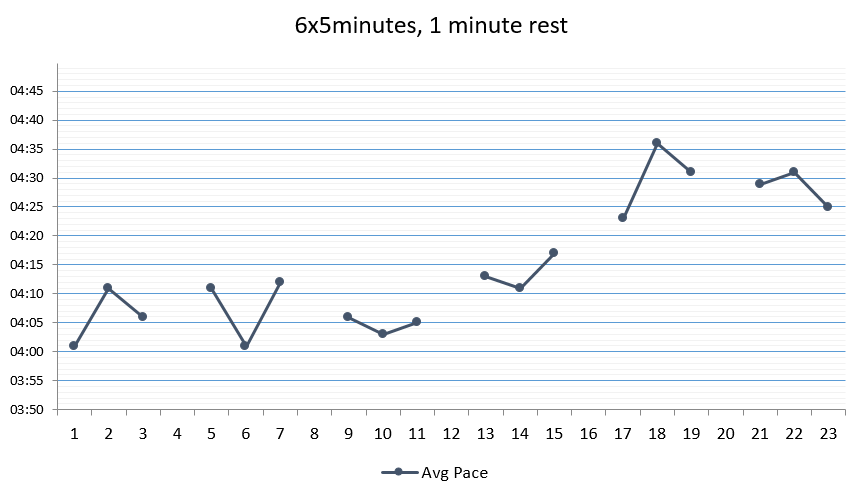
As is my usual modus operandi, the first 15 minutes were just about on target, then it goes completely to crap as I get tired and worn out.
Now we’ll superimpose my heart rate during the session:
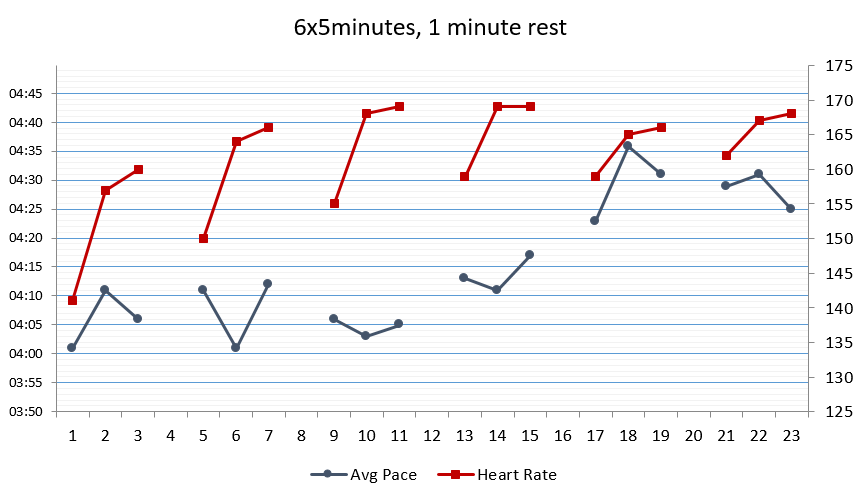
As you can see here, there’s not that great correlation between average heart rate per lap and pace. My heart rate goes up and up, and then stays fairly constant for the 3rd through to the 6th repetition, even though my pace is going haywire.
Next, though, we put power output on instead. Here’s something interesting:
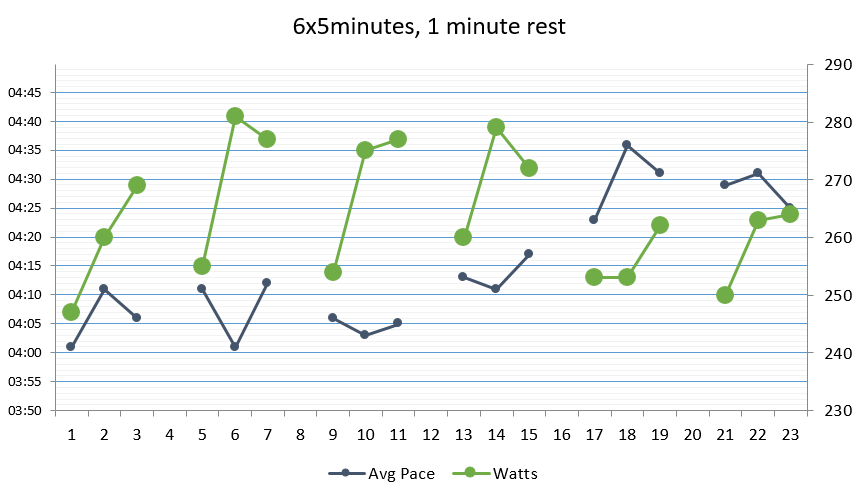
Power output was low for the first repetition, then stable for the next 3, and then drops off.
The first set was when I was running fastest, with the lowest power output of the first four repetitions – so we can infer that I was running much more efficiently in the first 5 minutes than the rest. So whereas before I’d have thought that things were fine for the first 15 minutes, it now looks like my form deterioated after 5 minutes, and so quite possibly I should adjust my target pace to be slower and make sure that’s consistent first.
Finally, let’s put watts/speed on here.
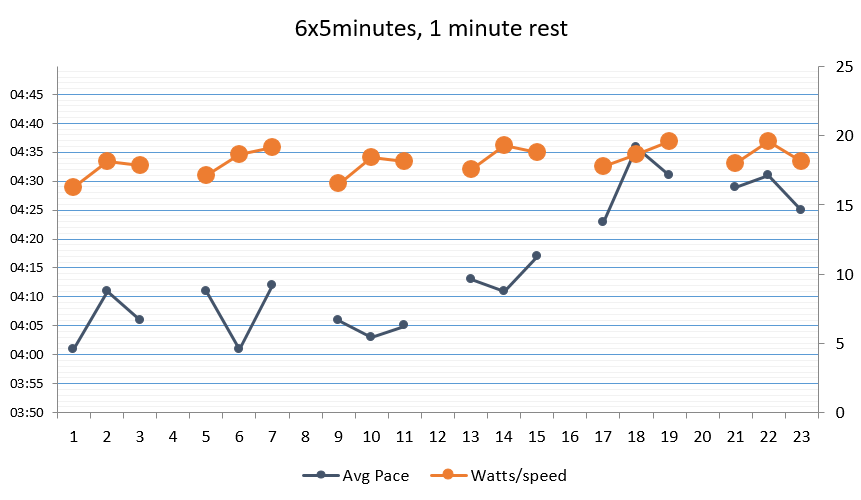
This is now probably getting close to abuse of ratios when I should be doing something more productive with my time, and I think right now it doesn’t show much, other than that as it appears to be quite consistent when we know other things are going all over the place, it means we either have a scaling problem here, or the chosen metrics aren’t at all helpful. Of course, I shouldn’t even be looking at these stats until I’ve got a good month’s worth of base data, and a decent visualisation guide, and a manual on training, next to me, so that’s next week’s project.
One response to “We need more power”
Always love a good graph. The actual meanings of these have me glazed over (too many graphs) but I like their cumulative attempt at climbing, like a representation of hope floating onwards and upwards.